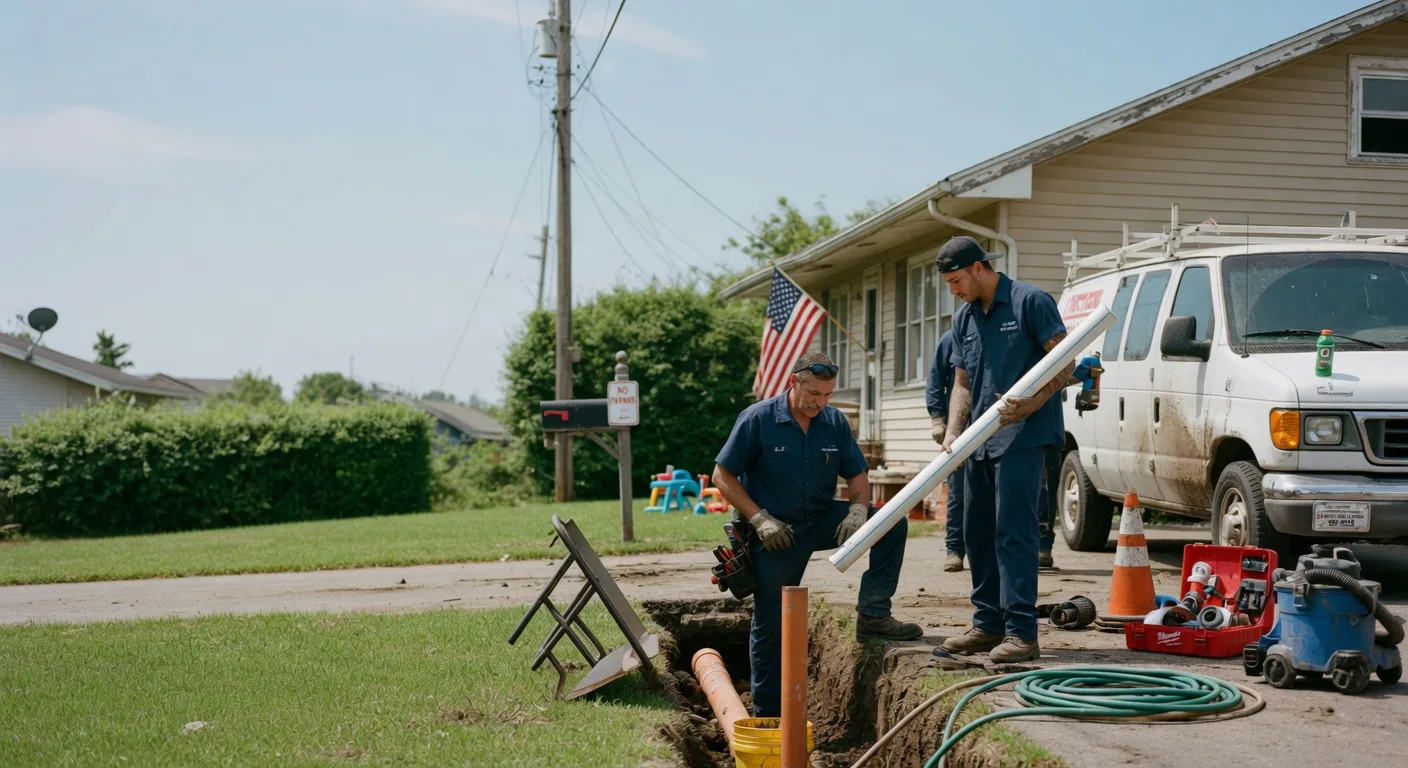
What does grease actually do to a drain pipe?
Grease leaves the sink as a liquid, and the pipe is where it stops being one. Warm fat cools on contact with the cold pipe wall and hardens into a waxy layer. That layer is slightly sticky, so it grabs coffee grounds, food scraps, and lint, and each meal adds another coat. Over weeks the opening shrinks like an artery, and water that used to flow freely starts to drain slowly and gurgle. Hot water does not fix this; it only carries the grease farther down the line, where it cools and sets again, sometimes in the main. That is why a kitchen sink that slows while every other fixture drains normally is nearly always grease in the branch line close to the trap. A cable machine cuts a channel through the buildup and often restores flow, but the coating stays on the pipe wall and narrows again within weeks. Hydro jetting sends high-pressure water around the whole interior and strips the grease off the pipe wall, which is why it is the usual answer for repeat kitchen clogs. Wiping pans with a paper towel and putting fat in the trash prevents most of it. Expert Plumbers Co connects homeowners with an independent local plumber who can tell whether a cable or a jetter fits the line. Access and the amount of buildup affect the job.
The place where most people go wrong is the hot water habit. Running hot water for a few seconds after washing dishes does not carry grease to the sewer, it only moves it down the line a few feet, where it cools and sets. A much better routine is to scrape plates into the trash, wipe greasy pans with a paper towel, and keep a jar for cooking oil that can go in the garbage once it is full. Dish soap makes grease look like it has dissolved, but it only breaks it into smaller droplets that still stick further along. Garbage disposals do not solve this either, since they chop food without removing the fat. In restaurants and busy households, a grease trap or interceptor may be present, and it needs regular emptying. If the sink has slowed repeatedly, mention that to the plumber, since a pattern points to a coating that needs scouring rather than another quick clear.
Is it safe to use chemical drain cleaner on a clog?
Chemical drain cleaner is best avoided on anything beyond a simple sink clog, and there are mechanical reasons for that. The liquid runs around a solid clog rather than through it, so it can sit in the pipe for hours without breaking anything loose. What it leaves behind is caustic. When a plumber then feeds a cable or a camera into that line, the standing chemical can splash or burn skin and eyes. Tell the plumber if you used any. On older galvanized or cast iron pipe, the chemicals can also worsen corrosion on a wall that is already rough or thin. In a bellied section they pool and stay in contact with the pipe far longer than intended. Never mix two products, and never use them in a toilet or in a line that is backing up from several drains. A plunger or a hand drain snake is the safer first step for one slow fixture. If a plunger or snake does not clear a single sink or tub, or if more than one drain is affected, the job needs a cable machine or hydro jetting from an independent plumber. Expert Plumbers Co can connect you with one in Edmonton, KY who handles this.
If you have already used a chemical product, the safest steps are simple. Do not add a second product or hot water on top of it, and do not run a plunger hard, since the splashback can contain caustic liquid. Wear gloves and eye protection if you need to go near the drain, and keep the room ventilated, because fumes can be strong in small bathrooms. Write down the product name and roughly how much was used, or keep the bottle, so the plumber can see the ingredients and take care when opening the trap. Pour no more down the line after you have called. A plunger used gently and a hand-operated drain snake do the same job without chemistry. Foaming enzyme products are milder, but they work slowly and only on soft organic buildup, not on hair, roots, or a damaged pipe. When in doubt, wait for the plumber.
Can a drain cable or hydro jetting damage old pipes like cast iron, clay or thin-wall pipe?
Yes, it can, and a good plumber knows that before the machine is switched on. Old pipe is not equally fragile everywhere, and the choice of tool depends on what the pipe is made of and what shape it is in.
Cable machines spin a cutting head against the pipe wall. In sound pipe that is fine. In clay with offset joints, the head can catch on a lip and snag. In cast iron with heavy scale, a cutting head can knock loose flakes, and in a pipe already thinned by corrosion it can punch through. Thin-wall plastic or older Orangeburg-type fiber pipe can be gouged or deformed.
Hydro jetting pushes water at high pressure through a nozzle. On solid pipe it cleans the walls better than a cable. On a cracked clay pipe, a corroded cast iron stack, or a joint that has already shifted, that pressure can widen the damage or send water out into the soil.
So how does the plumber decide? Usually from several clues:
The age and material of the house and the pipe, which tells the plumber what to expect.
Past history, such as repeated roots, earlier repairs, or a line that has never been inspected.
How the cable behaves. A head that bounces, stops at the same distance, or comes back with pipe chips or rust flakes suggests the pipe itself is damaged.
A camera look first. This is the most direct answer. If the line is fragile or offset, the plumber can choose a gentler head, lower pressure, or no jetting at all.
If you suspect old pipe, say so on the phone. Tell the plumber the age of the house and the pipe material if you know it. Ask whether the tool will be matched to the pipe, and whether a camera look comes first.
Sometimes the honest answer is that a quick clearing is worth the risk to get water moving, with a plan to inspect afterward. Sometimes it is not. Either way, the decision should be explained to you before the work starts, not after.
If you need a drain cleared in Edmonton, KY, Expert Plumbers Co can connect you with an independent local plumber at (380) 262-9173.
My sink gurgles after it drains and someone mentioned an air admittance valve. What is that, and can it fail?
"My sink gurgles after it drains" is one of the most common things people notice before a drain problem gets worse. Every fixture needs a vent so water leaving the trap does not pull a vacuum. When air cannot get in, it gets dragged through the trap water instead, and that is the gurgle.
An air admittance valve, or AAV, is a small one-way valve fitted on a vent pipe, often under a sink or in an attic. It opens to let air in as water drains, then drops shut so sewer gas stays in the pipe. Many local codes allow them and some do not, so rules vary by area.
Yes, they can fail. The rubber seal wears, dust or debris stops the flap seating, or the valve sticks. A valve that will not open brings back the gurgling and slow draining. One that will not close lets a sewer smell into the cabinet or room.
A blocked vent stack on the roof, a partial clog in the drain, or a bellied line holding water can also cause gurgling. One gurgling fixture usually points to its own trap, branch line or vent. If the tub, toilet and floor drain all gurgle together, or the toilet bubbles when the washer empties, suspect the main line or the main vent.
Safe homeowner check: Run just the gurgling sink and listen, then run another fixture and see if it does the same. Do not pry at vent parts inside walls, and do not pour drain chemicals into a line that is already gurgling.
Stop running water and call now if sewage smell is strong, water comes up in a tub, shower or floor drain when you use another fixture, a toilet bubbles or rises, or any fixture stops draining.
A cable machine is usually enough for a clog in a single branch line, like the pipe behind one sink. If the gurgle returns, or several fixtures are affected, the plumber may want a camera inspection to look for root intrusion at a clay joint, a bellied line, or a failing section. A blocked roof vent is cleared from the roof, not with a drain cable.
Expert Plumbers Co is a referral service. We connect you with an independent local plumber in Edmonton, KY. Call (380) 262-9173.
Ask the plumber whether an AAV is permitted where you live, or whether a conventional vent is needed instead. Cost depends on access to the pipe, the parts or materials needed, how much wall or ceiling has to be opened, and any permit or code requirement.
Our cabin or second home sat empty for months and now the drains smell and run slowly. Why?
You open the cabin for the first time in months and the drains smell like a sewer and the water creeps away.
Every fixture has a trap, the curved section that holds a little water to block sewer gas. With no use, that water evaporates. Once the seal is gone, gas comes straight up the drain. The film left in the pipe also changes while the house sits. Soap, grease and food residue dry and harden on the pipe wall, so the first heavy use narrows the line and water slows down. Then there is the line itself. A vacant house can still have roots working into a clay or cast iron joint, and nobody was flushing them back with daily flow.
If one sink or tub is slow and the others are fine, the problem is probably local to that fixture, its trap or its branch line. If every drain is slow, several fixtures gurgle, or the toilet bubbles when you run the washer, the blockage is further down, in the main line or the lateral to the street.
Safe homeowner check: run water in every fixture for a couple of minutes, including rarely used ones, to refill the traps. Pour a cup of water into floor drains. If the smell fades and the flow picks up after a day or two of normal use, dried traps and loosened residue were likely the whole story.
Stop running water and call now if wastewater comes up in a tub, shower or floor drain, if the toilet will not clear, if the smell stays strong after the traps are filled, or if you see wet floors, stained ceilings or sagging drywall.
A cable machine is enough when the clog is residue or a soft plug in one branch. If the line stays slow after cabling, if roots are suspected, or if grease has coated the full pipe wall, the plumber will usually recommend hydro jetting, which scours the pipe wall with high pressure water. A camera inspection settles the question of roots, a belly holding water, or a failed lateral.
Expert Plumbers Co is a referral service. We connect you with an independent local plumber in Edmonton, KY. Call (380) 262-9173.
Before you book, tell the plumber how long the house sat empty, whether it was winterized, and which drains are affected. Ask whether they plan to cable, jet or run a camera first, and what they will do if the camera shows roots or a damaged section. The scope depends on access to the line, the parts or pipe needed, how much has to be opened up, and whether a permit or code step applies to a repair.